01 / MACHINE
01 / 03 Machine views
FULL MACHINE
Complete machine arrangement
Overall machine view showing the complete fabric handling and spray finishing arrangement.
Opening the file straight from disk means the browser won't let the page read the .glb files sitting next to it. Either fix works.
A · Serve the folder — best option. In Terminal:
npm install && npm run dev Then open the local URL printed by Astro (normally http://localhost:4321)
B · Hand me the files — drop all three here:
 RVR Ramdukes
 A pad-mangle soaks fabric to 60–70% pick-up and then burns gas driving the water back off. This sprays what's needed onto both faces at 25%, and meters it electronically. Scroll, and the fabric starts running.
Fabric enters low, wraps a roller and climbs vertically through the gap between the two nozzle banks — which is why both faces can be treated in a single pass. It leaves over the top roller and drops away to the stenter chain.
The unit is a retrofit. The base carries the tank, pump and dosing circuit at floor level and takes the spray duct on the frame above, so the whole assembly drops into the entry of an existing 2450 stenter without moving the machine.
Everything from here on is the duct assembly, loaded as its own file so it can be shown at full detail without the rest of the machine in the way. Two mirrored banks face each other across the web on a common tilting frame.
Pitch and standoff are the two numbers that decide whether you get a uniform coat or twelve visible stripes. Measured off the assembly: 181.8 mm between nozzles, 245 mm from tip to cloth. The uniformity chart below works from exactly those figures.
An air-atomising head shears the liquid into fine droplets with compressed air instead of forcing it through a tiny orifice at high pressure. You get a soft, low-momentum cloud that lands on the surface rather than being driven into the yarn.
Profile rails and carriages hold the banks square to the web. If standoff wanders by ten millimetres across the width, the overlap between adjacent fans changes and you see it in the finished cloth — so the geometry is fixed mechanically, not adjusted by eye.
The complete assembly as exported, nothing decimated. From here the page turns into instrumentation — how add-on tracks line speed, how uniform the coat actually is across the width, and what the whole thing saves against a padder.
How it sprays
Every nozzle runs off its own solenoid — not a single shared line held open. Drag the controls to see why the timing matters.
Illustrative model of the switching behaviour, for explanation — production timing is tuned per chemistry, line speed and fabric.
At 50 Hz, each valve opens and closes fifty times a second — open for roughly a tenth of every cycle, closed for the rest. That's fast enough that the fabric never sees the gap: what reads as one steady mist is really thousands of individually timed micro-doses a minute, replayed too quickly to tell apart. It's the same trick as a dimmed LED — switch fast enough and the flicker disappears. Slow the switching down and you can watch it fall apart into drips and dry patches — try dragging the frequency slider to 15 Hz.
Frequency stays put; duty cycle is what the controller moves. Across the working speed range it runs from about 6% at a crawl to 50% flat out, holding grams per square metre constant the whole way. That relationship is plotted further down.
The nozzle array
Two bars facing each other across the web, each carrying twelve nozzles at 181.8 mm pitch. Turn a bank off and only one face gets finished.
Spray ON · Both faces — all 24 nozzles fire together continuously while the fabric moves through the centre.
Overall machine view showing the complete fabric handling and spray finishing arrangement.
Spray-system view showing the nozzle bank arrangement used to apply chemistry across the moving fabric.
Six reasons to spray
Six production advantages from the RVR Ramdukes spray system brochure, presented as a continuous horizontal technical carousel.
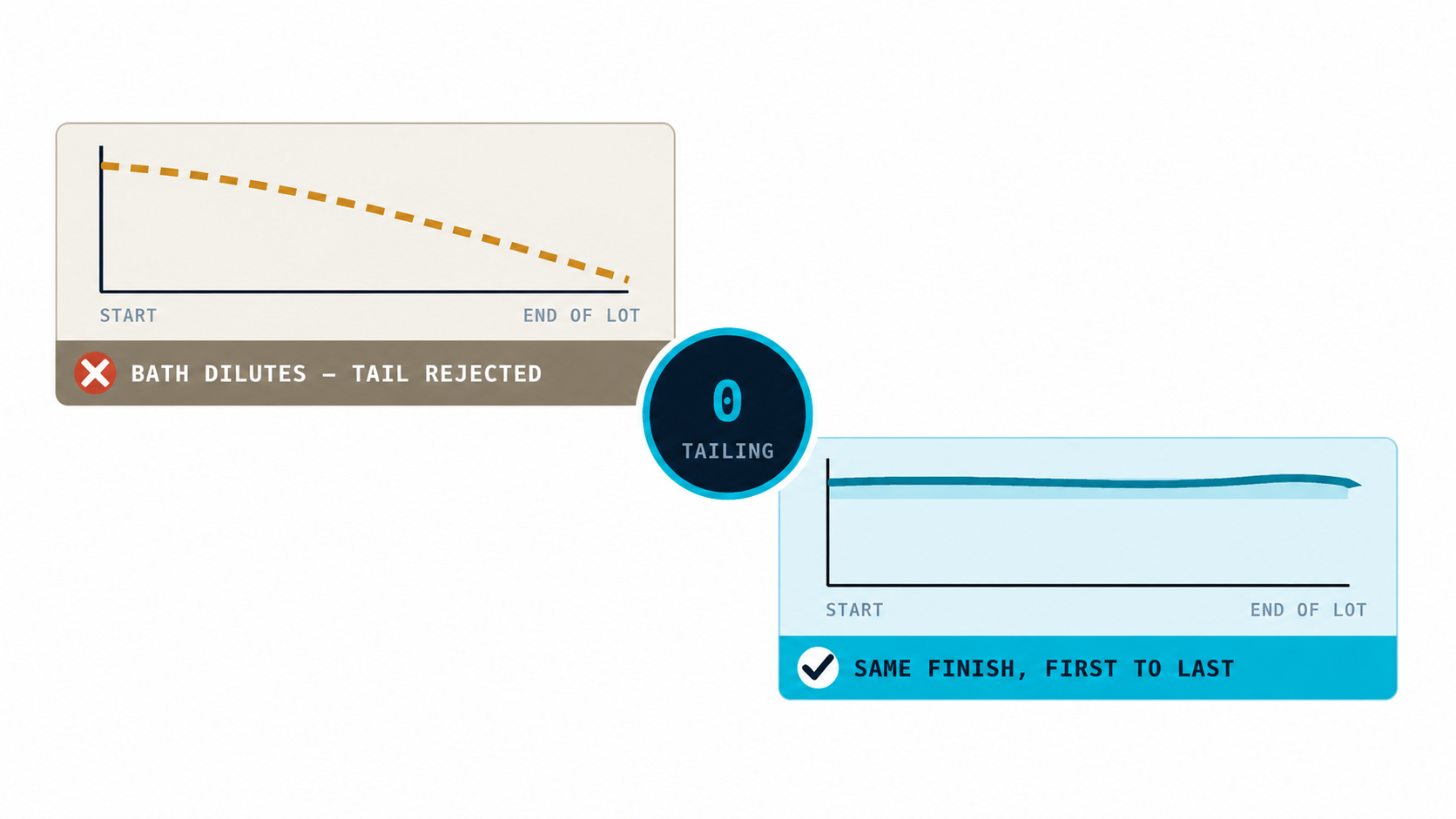 06 / 06 LOT CONSISTENCY
 There is no bath dilution and no tailing. Fresh chemistry is dosed against fabric width, GSM and line speed so the last metre is finished like the first.
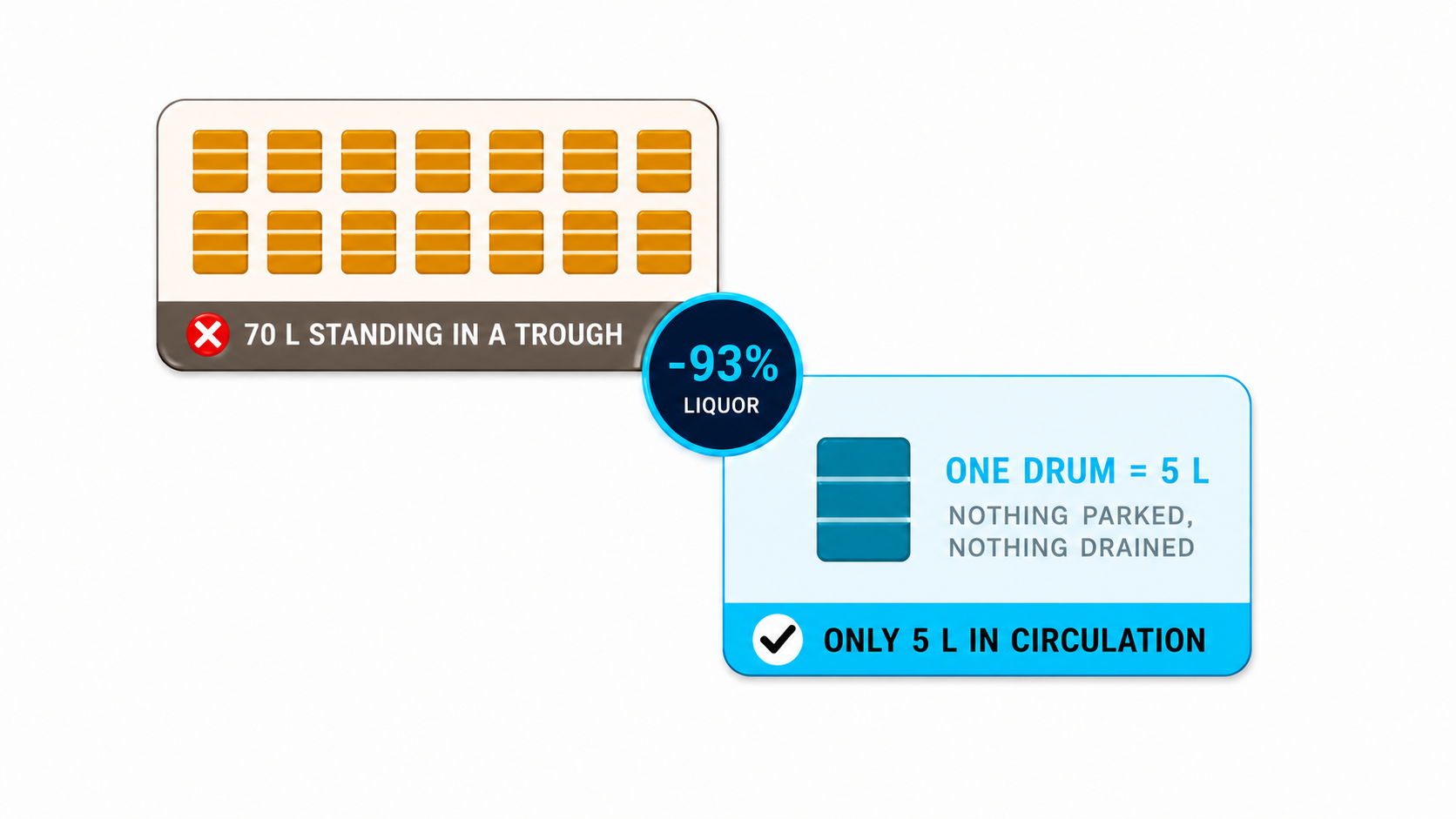 01 / 06 LIQUOR CONTROL
 Only the chemistry required is metered onto the moving fabric. About 5 L stays in circulation instead of roughly 70 L standing in a conventional padder bath.
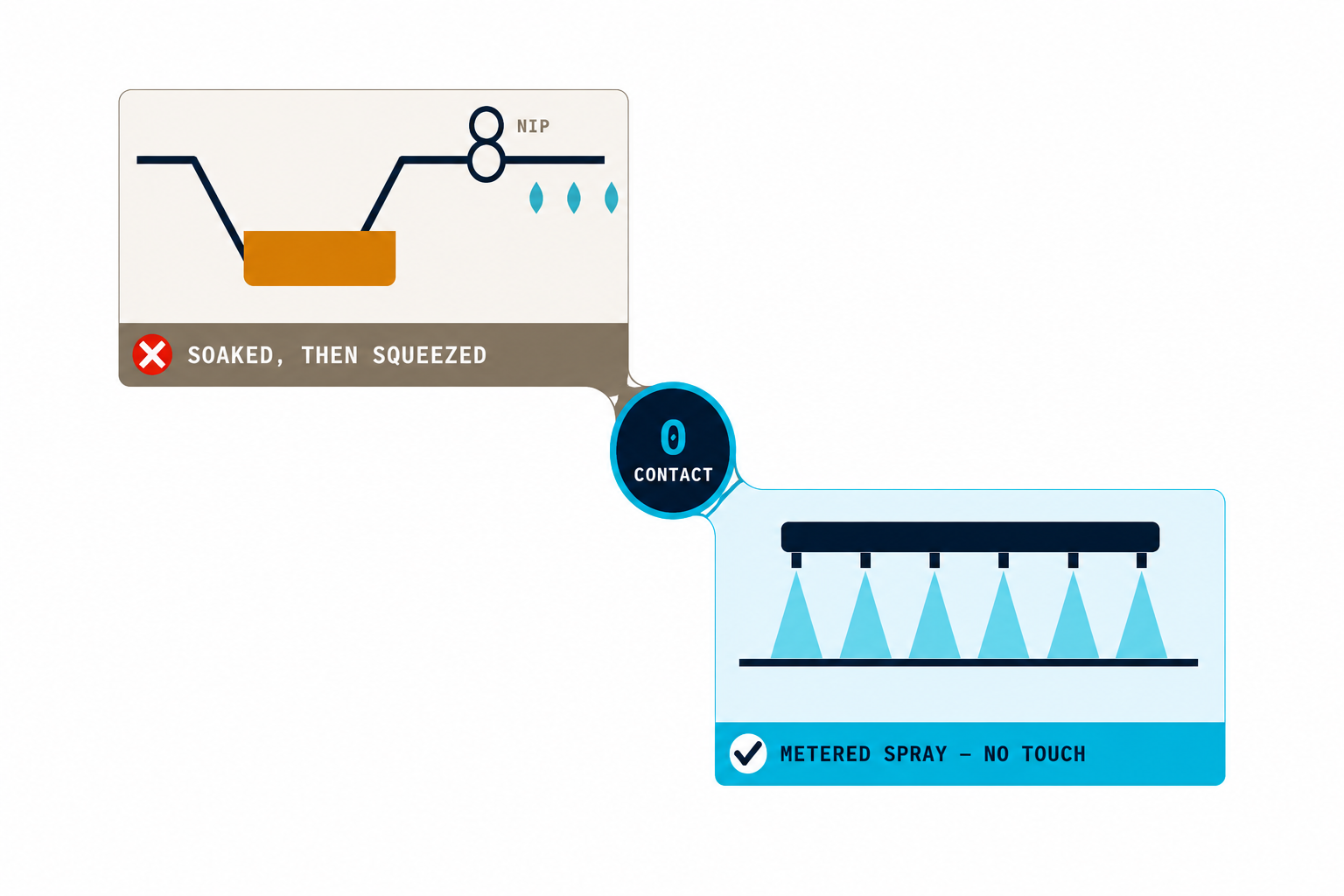 02 / 06 NON-CONTACT APPLICATION
 Twenty-four digital nozzles apply chemistry directly to the running fabric without a nip or applicator touching the cloth.
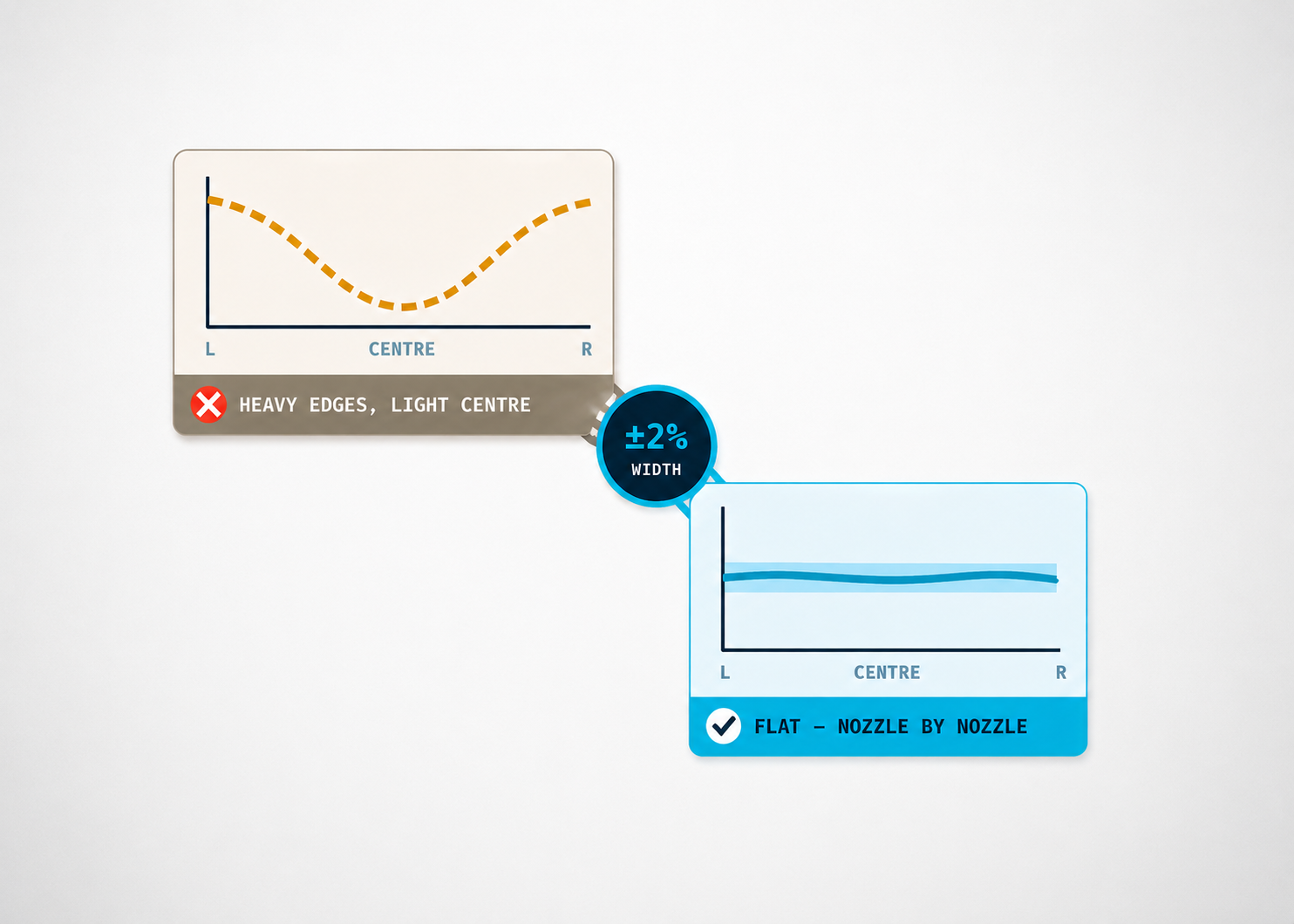 03 / 06 WIDTH UNIFORMITY
 Every nozzle is controlled independently so the finish stays uniform from centre to selvedge across the complete fabric width.
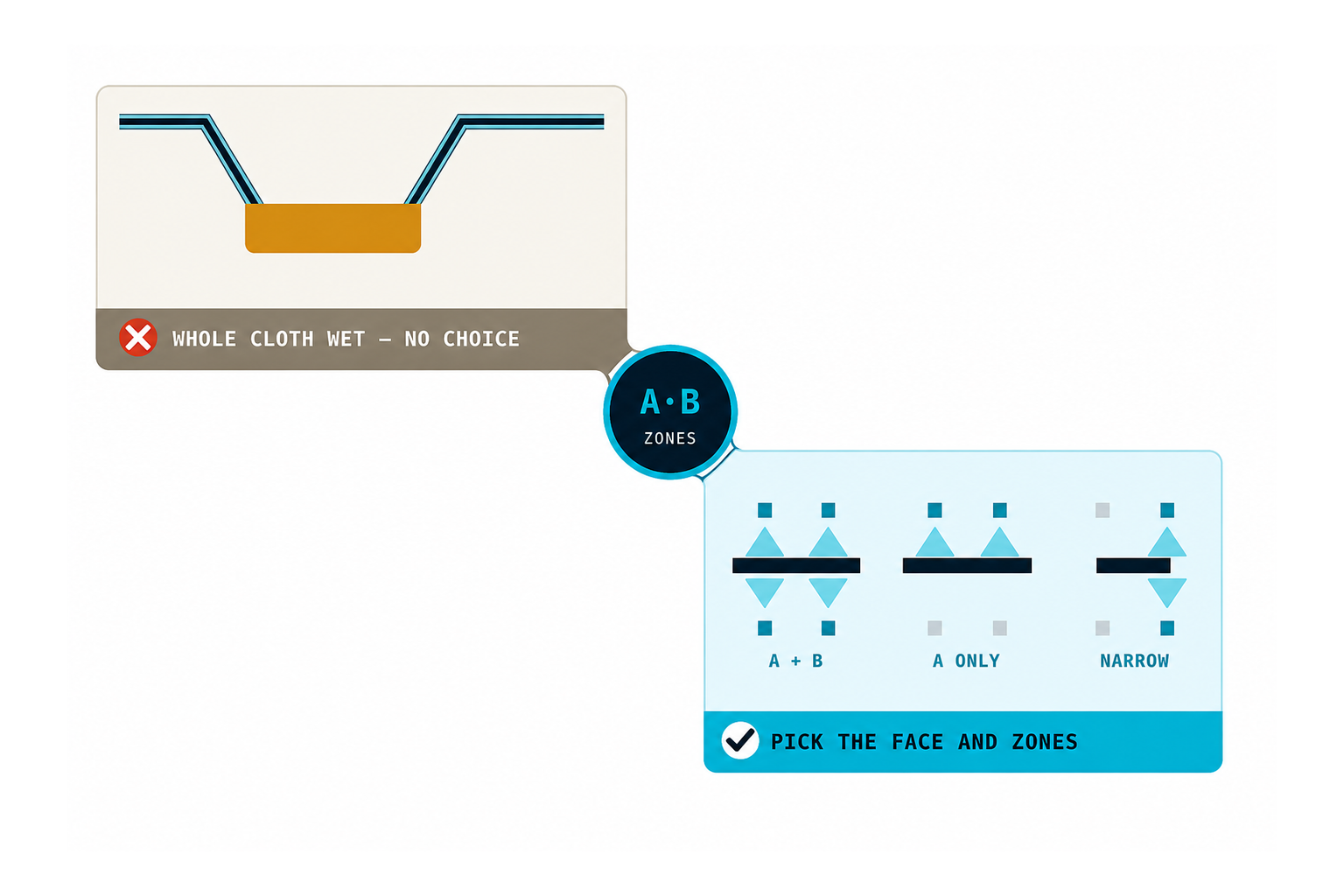 04 / 06 SELECTIVE FINISHING
 The operator can select both faces, A only, B only, or a narrow set of nozzle zones so chemistry is not sprayed into empty space.
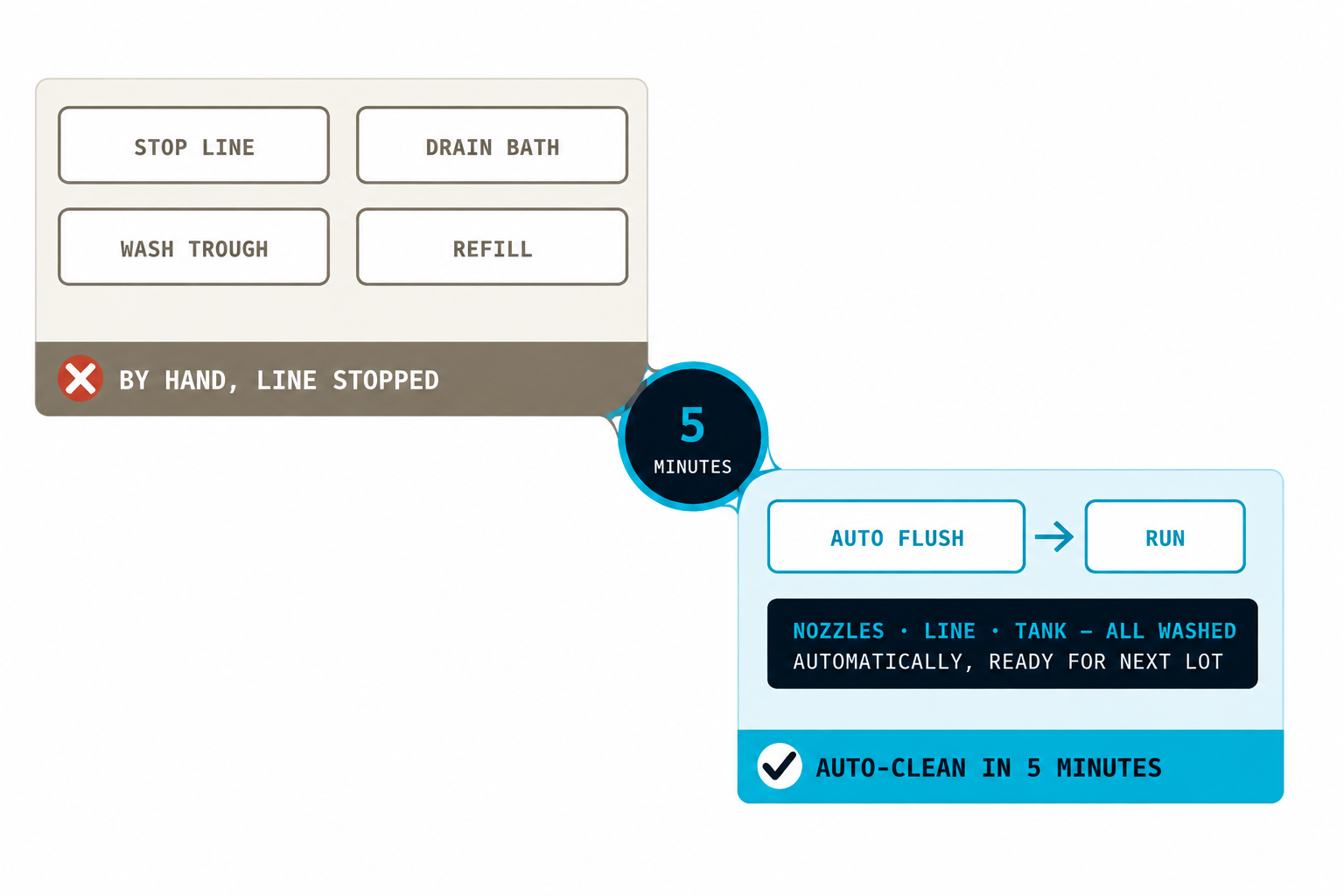 05 / 06 CHANGEOVER
 Eight automatic valves flush the nozzles, line and tank. The complete spray circuit is cleaned and ready for the next recipe in approximately five minutes.
06 / 06 LOT CONSISTENCY There is no bath dilution and no tailing. Fresh chemistry is dosed against fabric width, GSM and line speed so the last metre is finished like the first.
01 / 06 LIQUOR CONTROL Only the chemistry required is metered onto the moving fabric. About 5 L stays in circulation instead of roughly 70 L standing in a conventional padder bath.
02 / 06 NON-CONTACT APPLICATION Twenty-four digital nozzles apply chemistry directly to the running fabric without a nip or applicator touching the cloth.
On the line
The unit is a retrofit. It drops into the entry of a stenter the mill already operates, where the padder used to sit.
The roll unwinds and threads in exactly where a padder used to sit.
Twelve or twenty-four nozzles dose the moving web — no bath in between.
Straight into the stenter frame you already have. No separate dryer to add.
Rolled up — and the trough that needed draining and remixing simply isn't there.
Build the mill case
Four things a finishing manager is actually buying — then the arithmetic underneath them.
Run both spray bars or isolate one face according to the finishing recipe.
Valve timing is an explicit process setting instead of relying only on mechanical bath pickup.
Designed around a line the mill already operates, not a separate finishing island.
Each position is visible, testable and serviceable rather than hiding the whole application system in one element.
The saving is mostly gas, not chemistry — it's the water that never had to be put on the cloth and then driven back off. Active add-on is the same either way.
Straight answers
Including the ones where the honest answer is “not this machine”. You will hear these in the first meeting — better they are answered here.
This is the right question to ask about any spray system, and the answer is filtration plus flushing — not hope.
Two 430 strainers sit in the circuit ahead of the pump, and the liquor is filtered again before the manifolds. Because every position has its own valve, a partial blockage shows up as one narrow stripe rather than a ruined batch — and the controller can flag the position whose flow has drifted.
Each nozzle unclips from its own port. There is no header to strip down to reach one of them.
Straight answer: it will block if you run unfiltered liquor or leave chemistry standing in the lines overnight. Filtration spec and an end-of-shift flush cycle are part of the commissioning, not optional extras.
Technical data
Working range, utilities, footprint, controls and service intervals — the pack a project engineer asks for on the first call.
| Working width | 2 000 mm · measured from the assembly |
|---|---|
| Fabric weight | 40 – 400 g/m² ▲ |
| Line speed | 5 – 80 m/min · limited by stenter drying, not by the spray ▲ |
| Add-on range | 10 – 120 g/m² · both faces combined ▲ |
| Add-on repeatability | ± 3 % · to be confirmed against trial data ▲ |
| Faces treated | 1 or 2, selectable per recipe |
| Liquor viscosity | ≤ 50 cP ▲ |
| Liquor pH | 3 – 11 · wetted parts stainless and PTFE ▲ |
| Particle size in liquor | < 100 µm after filtration ▲ |
▲ Figures marked this way are engineering estimates or standard offerings pending confirmation against your build. Everything unmarked is measured directly from the CAD assembly. Confirm the marked items before issuing a quotation.
Where it's used
Two banks, independently gated — so the two faces of the cloth do not have to get the same thing.
Softening and hand-feel finishes without a full-immersion bath.
Water repellents dosed precisely, without over-wetting the fabric.
Fire-retardant and anti-microbial finishes applied at higher, targeted concentration.
Durable water repellent finishing, replacing a padder in an existing line.
Anti-microbial and anti-odour finishes with no cross-batch bath contamination.
Stain-resistant finishing on wide, heavier-gsm fabrics.
Measured from the assembly
Pitch, standoff, bank separation and working width are computed from part positions in the glb, not quoted from a datasheet.
Notes
Worth reading before you put it in front of a customer.
Browsers won't let a page opened from your hard drive read other files sitting beside it — the same rule that stops a downloaded page rifling through your documents. The models are separate files, so they trip it. Running python3 -m http.server 8000 in the folder turns it into a proper site on your own machine and the restriction lifts. The drag-and-drop panel is the fallback when you can't.
Everything geometric is measured: 24 nozzles, 181.8 mm pitch, 667 mm between banks, 245 mm standoff, 2 000 mm web, the vertical fabric pass, 16 Festo ADNGF-32-80 cylinders, the DAPS actuators and the Keyence sensor are all read out of your assembly. The performance figures are modelled — duty cycle, flow, droplet size, CV% and the savings comparison come from standard spray and drying relationships, sized to this machine's geometry. They behave correctly and the numbers are defensible, but they are not measurements from a running line. Replace them with trial data before quoting.
On this machine the web runs vertically and the two banks sit either side of it, 667 mm apart. The array diagram is therefore drawn looking down on the machine: the horizontal axis is the 2 000 mm working width, the two bars are the two banks, and the fabric travels out of the page. That is the same layout your earlier page used — it just wasn't labelled as a plan view.
Hiding a component loses the context of where it sits. Dropping everything else to about 20% and tinting the subject keeps the whole machine visible while making one thing unmistakable. The same mechanism serves two jobs — scrolling drives it automatically, and clicking any part drives it manually.
133 MB across three files, 2.95 million triangles, nothing decimated. The 24 nozzles alone are 419 000 triangles and three M16 bolt patterns another 171 000 — turn the Fasteners button off to drop those. For anything customer-facing, run the files through Draco or meshopt; this assembly compresses to roughly a tenth.
Book a trial
Nothing on this page settles the question for your cloth. A trial does, and it takes an afternoon.
If the answer is that a padder suits your fabric better, we will tell you that. It is a shorter conversation than a bad installation.